Standards and blanks
Plan standard concentrations, blank wells, replicate layout, and total well demand for supported 96-well workflows.
 BenchLine
Home
BenchLine
Home
96-well plate planner
BenchLine supports 96-well standards plate planning for trained laboratory users, including assay standards, blank wells, replicate allocation, preparation volumes, plate maps, and exportable calculation-support records.
Plan standard concentrations, blank wells, replicate layout, and total well demand for supported 96-well workflows.
Calculate theoretical preparation volumes from source stock through the highest standard and subsequent standard levels.
Review a clear 96-well allocation and export selected plate map information for calculation-support documentation.
Invalid plans block supported save and export actions, while final use still requires SOP, assay, and professional review.
BenchLine combines dilution, molarity, buffer, serial dilution and laboratory conversion workflows in one iPhone app.
View BenchLine on the App StoreStart with a 2,000 µM stock. Set the highest standard to 1,000 µM and a two-fold series to obtain 1,000, 500, 250 and 125 µM. Allocate two 100 µL wells per standard and two blank wells.
For this example, use 200 µL minimum usable volume per standard, 20% overage and 0 µL additional dead volume. The required retained volume is 240 µL per standard. Preparation volumes also cover the transfer needed to make the next standard.
| Standard | µM | Source | Transfer in | Diluent | Prepared | Transfer to next |
|---|---|---|---|---|---|---|
| S1 | 1,000 | Stock (2,000 µM) | 225 | 225 | 450 | 210 |
| S2 | 500 | S1 | 210 | 210 | 420 | 180 |
| S3 | 250 | S2 | 180 | 180 | 360 | 120 |
| S4 | 125 | S3 | 120 | 120 | 240 | 0 |
For S1, 225 µL of 2,000 µM stock plus 225 µL diluent gives 450 µL at 1,000 µM. Transfer 210 µL to S2, leaving 240 µL. The same balance applies down the series. Prepare 240 µL of the appropriate blank diluent separately.
| Row | 1 | 2 | 3 | 4 | 5 | 6 | 7 | 8 | 9 | 10 | 11 | 12 |
|---|---|---|---|---|---|---|---|---|---|---|---|---|
| A | S1 | S1 | S2 | S2 | S3 | S3 | S4 | S4 | BL | BL | — | — |
| B | — | — | — | — | — | — | — | — | — | — | — | — |
| C | — | — | — | — | — | — | — | — | — | — | — | — |
| D | — | — | — | — | — | — | — | — | — | — | — | — |
| E | — | — | — | — | — | — | — | — | — | — | — | — |
| F | — | — | — | — | — | — | — | — | — | — | — | — |
| G | — | — | — | — | — | — | — | — | — | — | — | — |
| H | — | — | — | — | — | — | — | — | — | — | — | — |
Standards occupy A1–A8; blanks occupy A9–A10. This illustrative map uses 10 of 96 wells. It does not allocate unknown samples or perform curve fitting.
In BenchLine, save a valid setup for repeat work. Export the preparation table or plate map as CSV, or a supported calculation report with inputs, assumptions and warnings.
These downloads describe this website example. They are calculation-support illustrations, not a validated assay protocol or a substitute for checking your method.
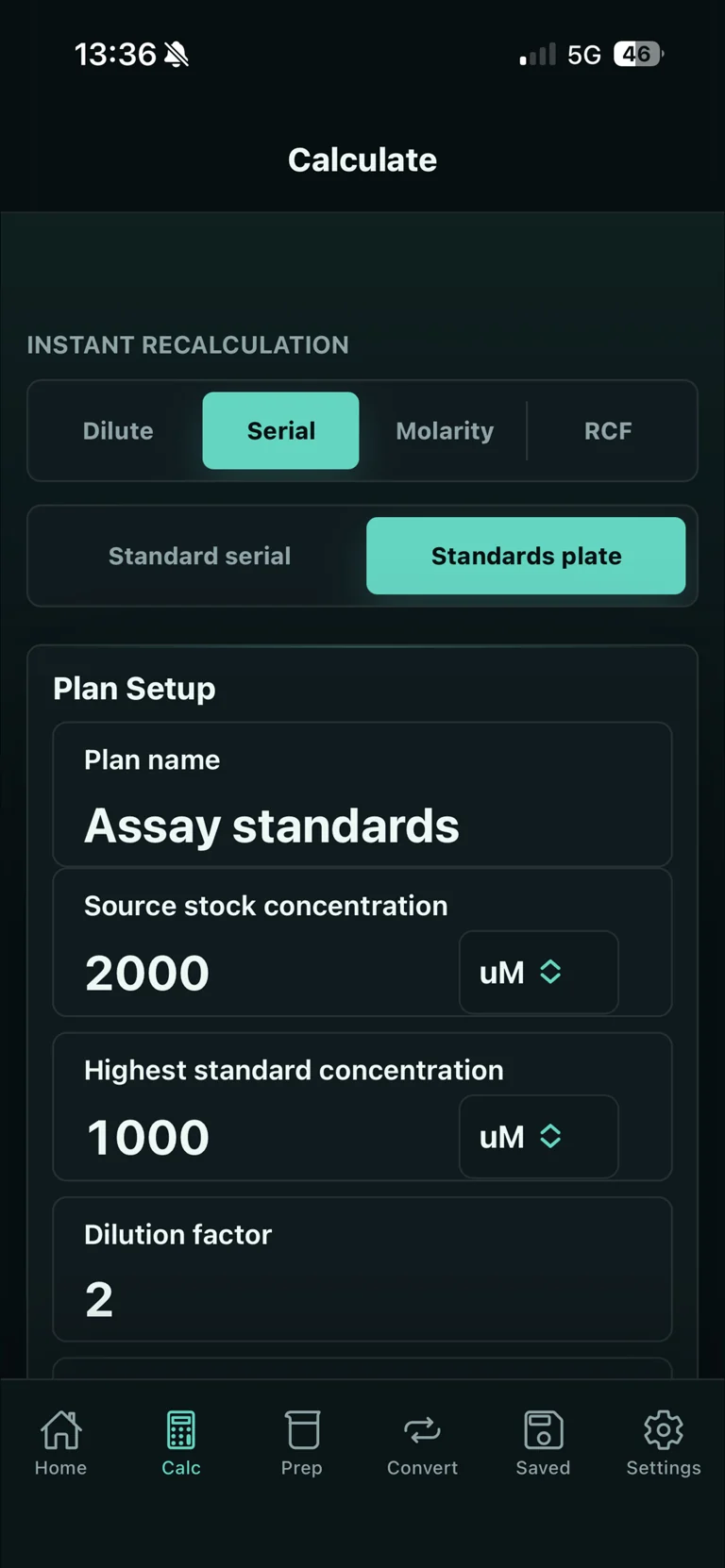
Volumes are theoretical. Check pipette limits, mixing, reagent compatibility and any extra dead volume required by your method. BenchLine does not automatically validate assays or design intermediate dilution schemes.
BenchLine supports standards plate planning for trained laboratory users, including source stock concentration, highest standard concentration, dilution factor, preparation volumes, standards, blanks, replicates, and 96-well plate map outputs.
BenchLine can export calculation-support reports and selected CSV outputs, including preparation and plate map information for supported standards plate workflows.
No. BenchLine provides calculation and planning support. Users must verify layouts, pipette limits, reagent stability, assay requirements, and local SOPs before use.
BenchLine does not replace assay validation, laboratory records, ELN/LIMS systems, protocol approval, or peer review. Check all plate plans against the relevant assay method before bench use.